
Beyond the Stock-Bond Mix: Broadening the Sources of Income
2026-09-22

If you are an investor with a low to moderate risk tolerance, are retired or planning for retirement, or are investing toward a relatively medium-term goal, bonds probably play an important role in your balanced portfolio. They complement your equity holdings by helping generate income and providing diversification when stock markets go through more difficult periods.
That role remains entirely relevant today.
A bond essentially represents a contractual commitment by an issuer to make the scheduled interest payments and repay principal according to the agreed terms, subject to its financial capacity. This predictability should not, however, make us forget that a bond’s market value can fluctuate, particularly when interest rates change. A useful comparison is an income-producing property. Its market value can rise or fall with market conditions without preventing the owner from continuing to collect rent. Similarly, a bond investor can continue to receive the scheduled payments even if the bond’s market value fluctuates.
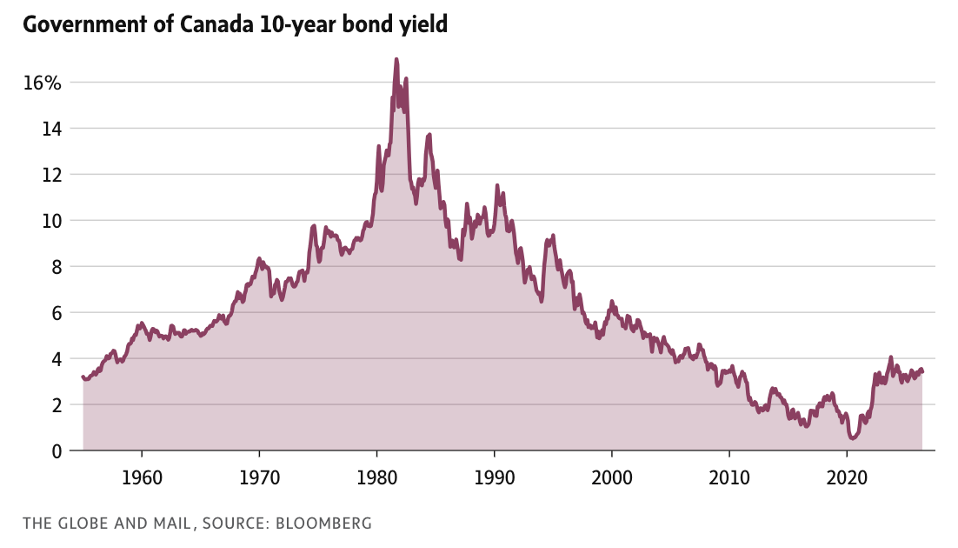
Government of Canada 10-year bond yield. Source: The Globe and Mail, Bloomberg data.
An Evolving Stock-Bond Relationship The issue that deserves your attention today therefore lies elsewhere: diversification.
For many years, stocks and bonds often reacted differently to the same economic events. This low correlation has been one of the main advantages of the traditional balanced portfolio composed, for example, of 60% equities and 40% bonds. That said, in certain environments—particularly when inflation and interest rates become dominant factors—stocks and bonds can move in the same direction at the same time. In such an economic regime, their ability to offset one another can temporarily diminish because of a higher positive correlation. There are several reasons to believe we may currently be experiencing such a regime, as illustrated by the chart below. The more the chart moves into negative territory (shown in red), the less bonds offset equity volatility, and this pattern appears to have intensified over the past three years.
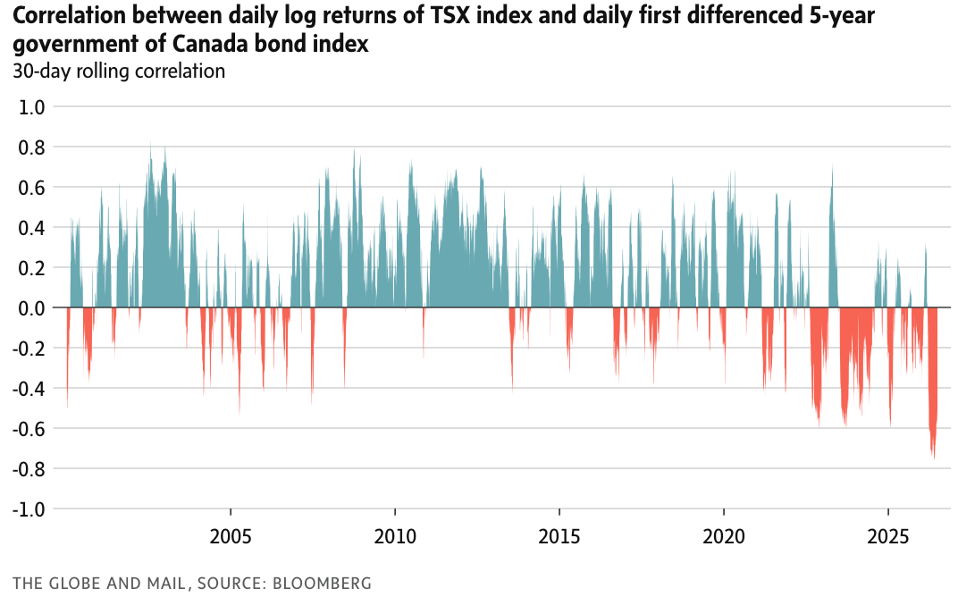
30-day rolling correlation between the TSX and 5-year Government of Canada bonds. Source: The Globe and Mail, Bloomberg data.
Such a situation should prompt you to act by preparing your retirement portfolio to better withstand future difficult periods in equity markets. The suggestion is certainly not to abandon bonds, but rather to add other diversifying sources of return and income to your portfolio.
Add Rather Than Replace
Three options deserve particular attention: liquid alternative strategies, commodities and real assets.
- Liquid Alternative Strategies Liquid alternative strategies give portfolio managers more tools to seek returns than simply holding stocks and bonds. A simple analogy is to think of it as “renting out your stock.” Rather than simply holding a share and hoping it appreciates, some strategies seek to generate additional income from securities you already own by lending them to other investors, who pay a fee for the privilege. Another example: a farmer concerned about a future increase in fuel prices may want to lock in a price today. On the other side of the transaction, an investor may agree to provide that protection in exchange for compensation. Futures contracts and options are among the instruments that can facilitate this type of transaction. Some strategies can also simultaneously take positions that benefit from increases in securities considered attractive and declines in others. Their results may therefore depend less on the overall direction of markets. Rather than diversifying by adding a new asset class, this is diversification through the addition of new strategies. These approaches nevertheless carry their own risks and can be more complex than a traditional fund.
- Commodities Gold, oil, natural gas, metals and certain agricultural products respond to factors that differ from those that traditionally influence stocks and bonds: supply and demand, production constraints, geopolitical events and inflation. This difference can contribute to diversification. In certain environments where an unexpected rise in inflation puts pressure on both stocks and bonds, some commodities may behave differently. Their role is therefore less about generating regular income and more about introducing exposure to different economic factors within the portfolio.
- Real Assets Real assets include real estate and infrastructure: buildings, energy networks, roads, transportation facilities and other physical assets that can generate rents, tolls or usage fees. These revenues can sometimes evolve with economic activity or inflation. Real assets can therefore provide sources of income and risk factors that differ from those of traditional markets. They are not immune to fluctuations, however: real estate and infrastructure can be sensitive to economic conditions, financing costs and interest rates.
Toward Broader Diversification The objective of these solutions is not to replace bonds. It is to add more strings to the diversification bow.
A portfolio containing many investments is not necessarily well diversified if they all react to the same economic factors. True diversification is instead about combining different sources of income, growth and risk that may respond differently across economic environments. Stocks and bonds diversify across asset classes. Liquid alternative strategies diversify the strategies being used. Commodities and real assets broaden exposure to different economic factors. Stocks and bonds can therefore continue to form the core of many portfolios. But in a world where their correlation can change, broadening diversification to include other strategies and risk factors can help build more resilient portfolios—without calling their foundations into question.
Sources and Further Reading Charts – The Globe and Mail / Bloomberg: view source. Source of the two charts reproduced in this article. Liquid Alternative Strategies – FINRA: view source. Overview of liquid alternative strategies, their diversification potential and their risks. Commodities – AQR: view source. Research on stock-bond diversification and the potential role of commodities in certain inflationary regimes. Real Assets – CAIA Association: view source. Analysis of the role of real estate, infrastructure and other real assets in relation to inflation and diversification.